
Author name: aaslahafarhana@gmail.com

Uncategorized

Google Ranking Facoters

Google Ranking Facoters 1. The Core Ranking Factors for 2026 To rank a blog post today, you must satisfy three distinct layers of Google’s algorithm: Intent, Experience, and Engagement. First-Hand Experience (The “E” in E-E-A-T) The most significant shift in recent years is Google’s ability to detect “Experience.” AI can explain how to do something, but it cannot describe how it felt or the specific hurdles encountered. Original Data: Include your own charts, surveys, or case studies. Personal Perspective: Use “I” or “We” to describe actual testing or usage of a product or service. Unique Assets: Original photography and custom diagrams are now massive ranking signals because AI cannot easily replicate them. Information Gain Score Google now calculates an “Information Gain” score. If your blog post says exactly what the top 10 results already say, your chances of outranking them are slim. To win, you must: Add a new angle or contrarian opinion. Provide a deeper level of detail that competitors missed. Offer downloadable tools, templates, or checklists that add utility beyond text. 2. Content Creation Checklist Mastering Search Intent In 2026, keywords are just the “flavor,” but Intent is the “meal.” Google categorizes intent into: Informational: “How to…” (Best for long-form blogs). Navigational: Looking for a specific brand. Commercial: “Best [Product] for…” (Requires comparison tables). Transactional: “Buy [Product]…” (Requires fast-loading product pages). Formatting for “Skimmability” Google tracks user engagement metrics like Interaction to Next Paint (INP) and dwell time. If a user hits a wall of text and leaves, your ranking will drop. Title: Must be a <h1> tag and include the primary keyword near the start. Headers: Use <h2> and <h3> tags to create a logical hierarchy. Bullet Points: Use them for lists to keep the reader moving. 3. Visual Content & Technical Health Image Optimization Images are no longer optional. Google’s “Multimodal” search (Gemini) reads your images to understand the page. Alt Text: Describe the image for accessibility and SEO. Placement: Place images near the text they illustrate. Format: Use WebP or AVIF for fast loading. Technical Core Web Vitals Even the best human writing won’t rank on a slow site. Your blog must pass the CWV 2.0 standards: LCP (Largest Contentful Paint): Main content must load in under 2.5 seconds. INP (Interaction to Next Paint): The site must respond instantly to clicks. CLS (Cumulative Layout Shift): Elements shouldn’t jump around as the page loads.
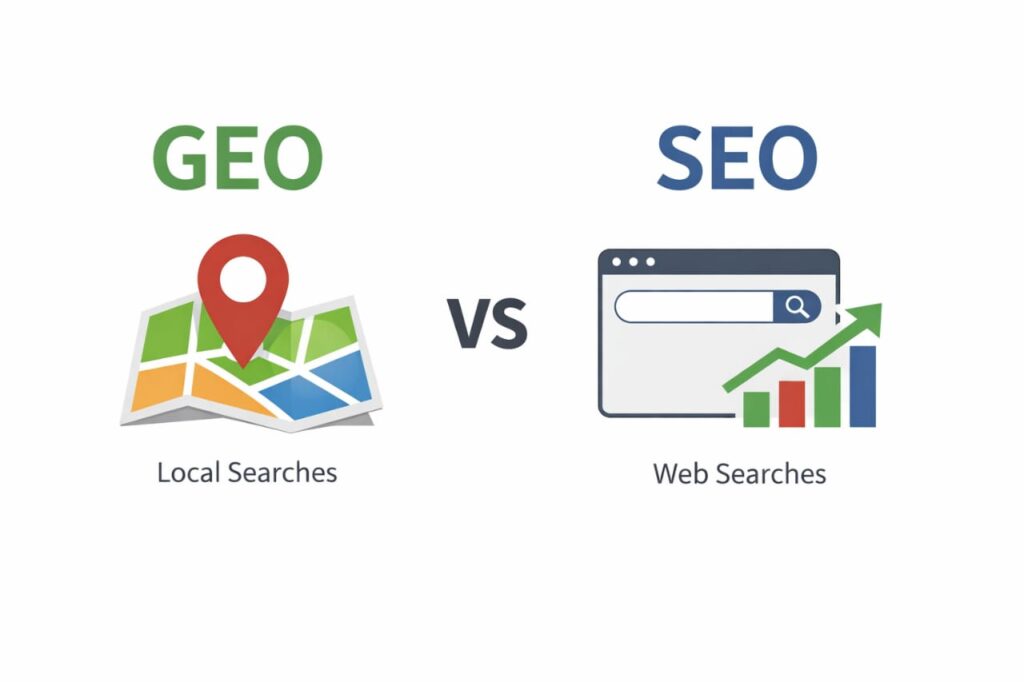
Difference Between Generative Engine Optimization (GEO) and SEO
Digital marketing

Difference Between (GEO) and SEO

What Is the Difference Between Generative Engine Optimization (GEO) and SEO ? Individuals do not just use Google anymore. Nowadays, numerous users pose their questions on AI applications and answer-based search engines that do not provide links to websites but provide direct answers. Due to this development, a new optimization technique has developed known as Generative Engine Optimization (GEO). GEO is done together with the conventional technique which is Search Engine Optimization (SEO). This blog is a short description of what is SEO and GEO and their differences. 1. What SEO (Search Engine Optimization) Is.   SEO refers to the operation of enhancing a site in such a way that it is ranked higher in search engines on sites such as Google Bing and Yahoo. SEO intends to enable people to discover your site on the search of the relevant issues. Main Goals of SEO Gain visibility of the websites. Drive organic (free) traffic Appear in the first few pages of the search engine results pages (SERPs). How SEO Works Search engines index and scan your content and rank it in terms of quality relevance and usability. SEO enables search engines to know what is contained in your content so as to be displayed to the appropriate audience. Core Components of SEO    On-Page SEO High-quality content Keyword optimization Meta description and titles. Header tags (H1 H2 H3) Internal links and readability. Off-Page SEO Other websites back linking. Brand mentions Social sharing Technical SEO Website speed Mobile friendly design Secure HTTPS connection XML sitemaps Clean URL structure Example of SEO Imagine that you have done a search Best study tips for exams and SEO will allow your blog to be on the first page of Google making this bring more people to your site. 2. What Is GEO (Generative Engine Optimization)? GEO is dedicated to the optimization of content in order to be utilized and referenced by AI applications such as chatbots and generative search engines. Rather than fading in the ranking of clicks GEO assists your content to be shown in AI generated results. Main Goals of GEO Be content in AI responses. Give straight forward answers. Develop power and credibility of AI systems. How GEO Works Predictable formatted factual and well-written content is presented in GEO that can be easily comprehended and summarized with the help of AI tools. It puts more emphasis on clarity accuracy and context more than on keywords. 3. The main difference between SEO and GEO lies in their differences. SEO GEO Targets search engines Targets AI tools. Goal on clicks on the web site Goal on inclusion of answers. Context and intent-driven Keyword-driven Rankings are important Citations and summaries are important. Conclusion The former, SEO, is needed to make people find your site, whereas the latter, GEO, enables the AI tools to utilize your content as a solution. Both are important today. A combination of SEO and GEO is a sure way to keep your content visible in both pre-modern and modern AI-driven search engines.

Scroll to Top